

For decades, the image of the busy executive, briefcase in hand and boarding pass at the ready, has been synonymous with global business. The relentless cycle of flights, hotel rooms, and cross-continental meetings was accepted as an unavoidable cost of operations a necessary evil for closing deals, fostering partnerships, and managing international teams. However, this paradigm is undergoing a seismic and irreversible shift. A confluence of technological advancement, economic pressure, and a re-evaluation of work-life balance is propelling us toward a new era: the age of the holographic meeting. This isn’t merely an upgrade to video conferencing; it is the dawn of immersive telepresence, a technology poised to render the vast majority of business travel obsolete. By projecting life-size, three-dimensional representations of participants into remote spaces in real-time, holographic communication offers the nuance, presence, and collaborative power of physical meetings without the associated costs, inefficiencies, and environmental toll.
The limitations of current digital communication tools have long been the bottleneck for fully remote collaboration. Video calls, while revolutionary in their own right, suffer from a phenomenon known as “Zoom fatigue.” This stems from a cocktail of factors: the flat, two-dimensional nature of interaction, persistent latency that disrupts natural conversational flow, the cognitive strain of interpreting non-verbal cues from a grid of faces, and the infamous “mute button” faux pas. These platforms often hinder serendipitous side conversations, make complex spatial demonstrations (like product prototyping or architecture walkthroughs) nearly impossible, and fail to replicate the shared sense of “being in the room.” They facilitate information exchange but often at the expense of relationship-building and creative synergy. The market has been yearning for a solution that bridges the gap between digital convenience and physical immersion, and holography is answering that call.
The core technology enabling this revolution is a sophisticated blend of hardware and software advancements that would seem lifted from science fiction just a few years ago. The process begins with high-fidelity volumetric capture. Participants are recorded not by standard 2D cameras, but by arrays of sensors, depth cameras (like LiDAR or infrared), or specialized pods that capture a person from multiple angles simultaneously. This data creates a dynamic 3D point cloud or mesh model of the individual. This volumetric data is then compressed and transmitted over ultra-high-speed, low-latency networks, with 5G and burgeoning 6G standards being critical enablers. On the receiving end, the hologram is rendered and displayed. Display methods are diverse, ranging from transparent “holoprojector” screens that create a Pepper’s Ghost illusion, to dedicated light field displays that project images into free space, to augmented reality (AR) and virtual reality (VR) headsets that place holographic participants into fully digital or augmented environments. Artificial Intelligence plays a pivotal role, managing data compression, reconstructing missing visual data, synchronizing audio perfectly with lip movements, and even translating languages in near real-time with matching lip sync.
The business case for adopting holographic meetings is compelling and multifaceted, delivering profound ROI across several key areas:
A. Drastic Reduction in Operational Expenditure: Business travel is notoriously expensive. The direct costs airfare, luxury hotels, ground transportation, and per diems are substantial. Holographic systems require a significant initial capital investment in hardware and software, but this is a predictable, depreciable cost that pales in comparison to the recurring, variable, and often hidden expenses of travel. The indirect savings are even more impactful: the elimination of travel-related downtime, where employees are unproductive in transit, and the reduction in travel insurance and administrative overhead.
B. Exponential Gains in Productivity and Time Efficiency: The most finite corporate resource is time. Eliminating travel reclaims hundreds of hours per employee annually hours that were spent in airport lounges, taxi queues, and jet-lagged recovery. Meetings can be convened at a moment’s notice between continents. A executive in London can have a presential meeting with teams in Singapore, Sao Paulo, and San Francisco in a single morning, a logistical impossibility with physical travel. This compression of decision-making cycles and project timelines creates a formidable competitive advantage.
C. Environmental, Social, and Governance (ESG) Leadership: Corporate carbon footprints are under intense scrutiny. Aviation is a significant contributor to greenhouse gas emissions. By slashing air travel, companies can make immediate and reportable progress toward ambitious sustainability and net-zero goals. This enhances brand reputation, aligns with the values of a growing eco-conscious workforce and consumer base, and ensures compliance with increasingly stringent environmental regulations.
D. Enhancing Global Talent Acquisition and Inclusivity: Geography is no longer a barrier to talent. Companies can hire the best person for the role, regardless of their physical location, and integrate them into teams as if they were physically present. This also promotes inclusivity by providing equal presence and participation opportunities for employees who may have disabilities, caregiving responsibilities, or other limitations that make frequent travel challenging or impossible.
E. Elevated Collaboration and Human Connection: Unlike flat video, holograms preserve crucial social cues. Eye contact is natural you can intuitively tell who is looking at whom. Body language, gestures, and spatial positioning are conveyed authentically. This fosters greater trust, reduces misunderstandings, and enables more effective brainstorming and delicate negotiations. For tasks like collaborative 3D design review, medical procedure training, or virtual showroom walkthroughs, the ability to interact with and walk around life-size holograms is transformative.
The implementation of this technology is already moving beyond proof-of-concept into real-world applications across diverse sectors:

-
Corporate Boardrooms & Global Management: Strategic C-suite meetings, board presentations, and all-hands gatherings with a globally dispersed leadership team are conducted with a palpable sense of shared presence.
-
Research & Development (R&D): Engineers in Germany can interact in real-time with a holographic 3D model of a new engine component being physically held by a colleague in Japan, examining minutiae from every angle.
-
Healthcare & Medical Training: A world-renowned surgeon can project their hologram into an operating theater across the globe to guide a complex procedure, or medical students can practice on interactive holographic patients.
-
Higher Education & Academia: Leading professors can deliver lectures “in person” to multiple campuses simultaneously, and students from around the world can collaborate on holographic models in disciplines like archaeology, chemistry, or astrophysics.
-
Product Design & Automotive: Design teams can review full-scale holographic prototypes of new products or car interiors, making real-time adjustments to materials, aesthetics, and ergonomics without building costly physical mockups.
Despite its promise, the path to ubiquitous holographic communication is not without significant hurdles. The primary barrier is the current cost of high-end capture and display hardware, though this is expected to follow the typical technology adoption curve and decrease rapidly. Network infrastructure demands are steep, requiring widespread, robust 5G/6G and fiber optic backbones to handle the enormous data throughput with imperceptible latency. There are also important sociological and psychological adaptations needed overcoming the initial “uncanny valley” sensation, establishing new meeting etiquettes for holographic interaction, and managing the potential for digital exhaustion in a 3D format. Furthermore, significant data privacy and cybersecurity questions arise: who owns the volumetric data of a person’s likeness, and how is it secured from interception or manipulation?
The future trajectory of this technology points toward even deeper integration with our digital and physical lives. We are moving toward holographic interoperability, where standards will allow different systems from various manufacturers to connect seamlessly. The fusion with the Metaverse is inevitable, where persistent holographic offices and meeting spaces exist in shared virtual worlds, accessible via AR glasses or VR headsets. AI will evolve beyond translation to become an active meeting participant generating real-time holographic data visualizations, transcribing conversations with speaker identification, and even providing contextual background information on topics as they are discussed.
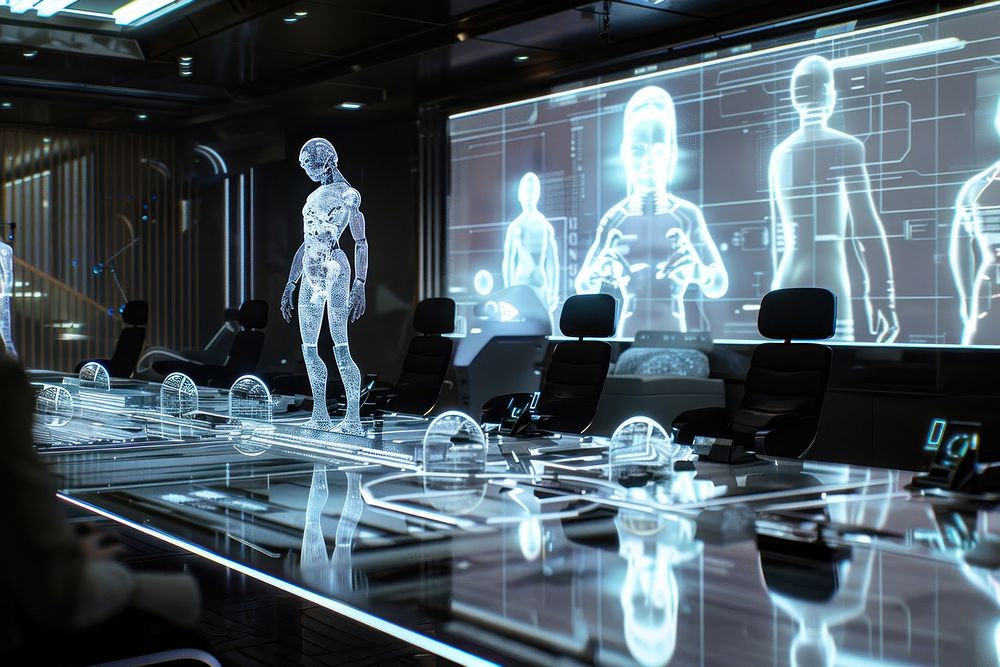
In conclusion, the holographic meeting is not a futuristic fantasy; it is the next logical, and perhaps final, step in the evolution of remote communication. It represents the convergence of our unmet need for authentic human connection at a distance with the technological capability to deliver it. While the jet-setting businessperson may not disappear entirely for certain high-stakes relationship-building, some travel will persist the default will irrevocably shift from “fly” to “project.” Companies that proactively explore and invest in this immersive telepresence ecosystem will position themselves at the forefront of efficiency, innovation, and sustainability. They will attract top global talent, accelerate their operational tempo, and dramatically reduce their overhead and environmental impact. The message for the modern enterprise is clear: the future of collaboration is not on a flight manifest; it is being rendered, in three dimensions, right before our eyes. The revolution is not coming; it is being logged into, one hologram at a time.